

As textile printing continues to grow and production demands increase, printers around the world are gradually moving from flatbed screen printing to rotary screen printing. The reason is simple: when orders become bigger, and customers begin demanding faster delivery, the limitations of a flatbed system can quickly become obvious.
For many Nigerian textile printers, flatbed screen printing remains a practical option, particularly for small orders, samples, and jobs where flexibility is more important than speed. But as production volumes increase, the repeated stopping, positioning, and registration involved in flatbed printing can slow down the entire process.
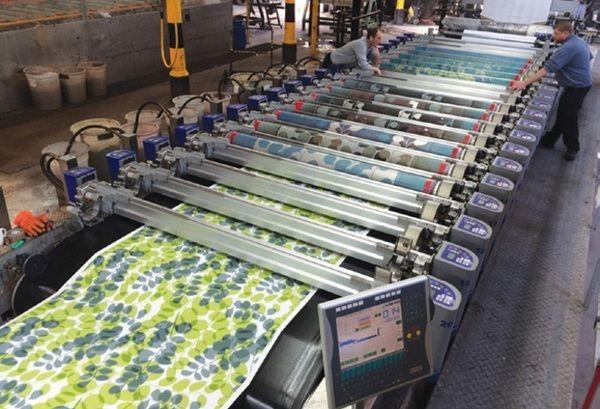
Rotary screen-printing works differently. Instead of printing on a stationary table, it uses continuously rotating cylindrical screens, allowing patterns to be printed continuously and at much higher speeds. This makes it more suitable for large-volume textile production where time, consistency, and output matter.
However, moving from a flatbed press to a rotary system is not simply a matter of buying a faster machine.
This is an important lesson for Nigerian printers considering the investment. A faster press cannot automatically fix problems that were already present in the artwork. Registration errors, unwanted moiré patterns, poor color separation, or repeats that do not join properly can still occur, and at a faster production rate.
In fact, a rotary press can reproduce a poorly prepared design just as accurately as it reproduces a good one. The difference is that it will produce the mistake much faster and in much larger quantities.
This is why the design and pre-production stage is becoming increasingly important as textile printers scale up. The success of the transition from flatbed to rotary is not determined by the press alone. The quality of the artwork, color separation, and repeat preparation can ultimately determine whether the investment delivers the expected results.
Getting the Design Right Before Production
This is where textile CAD software is becoming increasingly relevant. Poincare, a textile CAD software company, has developed a Print module designed to support screen, rotary and digital printing within the same application.
For a printer, this means a design does not necessarily have to be rebuilt every time the production method changes. A design can be developed and color-separated for a flatbed trial, then taken into rotary production when the order increases, without starting the entire process again.
The software supports color separation across up to 56 channels, allowing the design to be prepared according to the number of inks or screens required for the intended production process.
Another feature, Repeat Maker, automatically creates a closed and mathematically verified repeat. This can help eliminate one of the common problems faced when designs are moved into large-scale production, patterns that fail to connect properly when repeated across the fabric.
There is also the question of color. Natural Blend Color allows printers and designers to simulate how inks will interact before production begins. This gives them an opportunity to determine the required screens or cylinders before committing resources to physical production.
Files can also be sent directly to the printer without a separate RIP stage because the required spectral and production information is already embedded in the Poincare TIFF file.
For Nigerian textile printers, the bigger lesson is clear: investing in a faster press should go hand in hand with investing in better design and pre-production processes.
As production grows, the ability to prepare accurate artwork, manage color separation and create reliable repeats becomes just as important as the machine doing the actual printing.
As Freddy Brault, CEO of PoinBelow is a more natural, Nigerian-focused version written in a Printers Digest-style editorial tone professional, informative, and easy for industry readers to connect with.
From Flatbed to Rotary: Why Nigerian Textile Printers Must Look Beyond the Press
As textile printing continues to grow and production demands increase, printers around the world are gradually moving from flatbed screen printing to rotary screen printing. The reason is simple: when orders become bigger, and customers begin demanding faster delivery, the limitations of a flatbed system can quickly become obvious.
For many Nigerian textile printers, flatbed screen printing remains a practical option, particularly for small orders, samples, and jobs where flexibility is more important than speed. But as production volumes increase, the repeated stopping, positioning, and registration involved in flatbed printing can slow down the entire process.
Rotary screen-printing works differently. Instead of printing on a stationary table, it uses continuously rotating cylindrical screens, allowing patterns to be printed continuously and at much higher speeds. This makes it more suitable for large-volume textile production where time, consistency, and output matter.
However, moving from a flatbed press to a rotary system is not simply a matter of buying a faster machine.
This is an important lesson for Nigerian printers considering the investment. A faster press cannot automatically fix problems that were already present in the artwork. Registration errors, unwanted moiré patterns, poor color separation, or repeats that do not join properly can still occur—and at a faster production rate.
In fact, a rotary press can reproduce a poorly prepared design just as accurately as it reproduces a good one. The difference is that it will produce the mistake much faster and in much larger quantities.
This is why the design and pre-production stage is becoming increasingly important as textile printers scale up. The success of the transition from flatbed to rotary is not determined by the press alone. The quality of the artwork, color separation and repeat preparation can ultimately determine whether the investment delivers the expected results.
Getting the Design Right Before Production
This is where textile CAD software is becoming increasingly relevant. point Carre, a textile CAD software company, has developed a Print module designed to support screen, rotary and digital printing within the same application.
For a printer, this means a design does not necessarily have to be rebuilt every time the production method changes. A design can be developed and color-separated for a flatbed trial, then taken into rotary production when the order increases, without starting the entire process again.
The software supports color separation across up to 56 channels, allowing the design to be prepared according to the number of inks or screens required for the intended production process.
Another feature, Repeat Maker, automatically creates a closed and mathematically verified repeat. This can help eliminate one of the common problems faced when designs are moved into large-scale production, patterns that fail to connect properly when repeated across the fabric.
There is also the question of color. Natural Blend Color allows printers and designers to simulate how inks will interact before production begins. This gives them an opportunity to determine the required screens or cylinders before committing resources to physical production.
Files can also be sent directly to the printer without a separate RIP stage because the required spectral and production information is already embedded in the point Carre TIFF file.
For Nigerian textile printers, the bigger lesson is clear: investing in a faster press should go hand in hand with investing in better design and pre-production processes.
As production grows, the ability to prepare accurate artwork, manage color separation and create reliable repeats becomes just as important as the machine doing the actual printing.
As Freddy Brault, CEO of point Carre, puts it, printers considering the move from flatbed to rotary often focus too much on the press. But it is the design and color separation work that ultimately determines whether the investment delivers value.
For Nigerian printers looking to compete on quality, speed and consistency, the future may therefore not be about choosing between equipment and software. It is about making sure both work together from the very beginning. Care puts it, printers considering the move from flatbed to rotary often focus too much on the press. But it is the design and color separation work that ultimately determines whether the investment delivers value. For Nigerian printers looking to compete on quality, speed and consistency, the future may therefore not be about choosing between equipment and software. It is about making sure both work together from the very beginning.