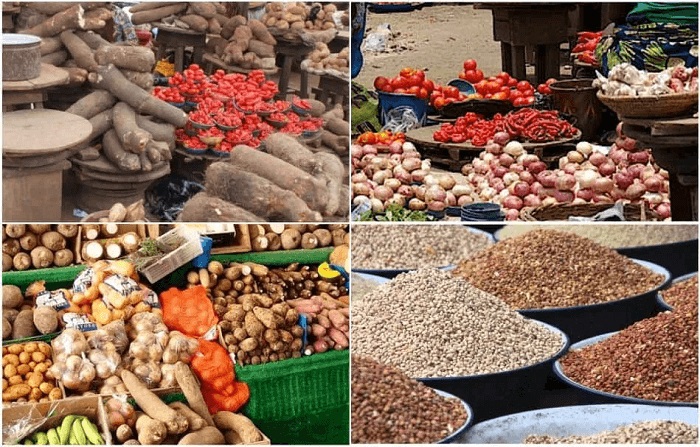


Nigeria’s inflation rate reached a 20 per cent mark in August 2022, reflecting the rising cost of living crisis facing Nigerian families and firms. It was the biggest inflation numbers since October 2005 with the cost food hitting 23.12 per cent on a year-on-year basis, representing a 2.82 percent increase from 20.30 per cent in August 2021.
On a month-on-month basis, inflation rose to 20.52 per cent in the month of August, from 19.64 per cent in July, according to the latest Commodity Price Index report published by the National Bureau of Statistics on Thursday.
The CPI measures the average monthly change in the prices of goods and services in a nation.
According to the NBS, the inflation rate was 3.52 per cent points higher compared to the rate recorded in August 2021, which was 17.01 per cent.
This means that in August 2022, the general price level was 3.52 per cent higher relative to August 2021.
The percentage change in the average CPI for the 12-month period ending August 2022 over the average of the CPI for the previous 12- month period was 17.07 per cent, showing a 0.47 per cent increase compared to 16.60 per cent recorded in August 2021.
According to the statistics body, the Increases were recorded in all classifications of individual consumption by purpose divisions that yielded the headline index.
Economist blames policy
An economist, Professor Akpan Ekpo, described the rising inflation as expected, considering Nigeria’s current economic realities.
The academic, who lectures at the University of Uyo, further stated the inordinate spending by the political class to fund their electioneering campaigns had also contributed to fuelling the inflationary pressure. This, he said, had led to “too much money chasing too few goods.”
“I’m surprised it’s not higher,” Ekpo said.
“That’s the problem, too much spending by politicians. The Central Bank of Nigeria is still giving the government money because they don’t know how to tell the government ‘No’. So, I don’t see the inflation rate coming down this year.”
Asked if the decision by the Monetary Policy Committee to increase base lending rate had helped curb the increase in inflation, Ekpo said, “What MPC does is to increase the interest rate to curtail growth and investment, but it doesn’t work because our economy is not the U.S economy. Their currency, the dollar, is both a domestic and an international currency. It is convertible.
“In our own case, naira is not convertible. So, the exchange rate gap, the gap between the official rate and the black market, is too wide. With the exchange rate regime strengthened by politicians spending money, I don’t see it coming down. The MPC may meet and increase the rate, it won’t change anything. They’ve done it twice, yet, as they do it, inflation keeps accelerating. So, they have to think of putting in place investment policies.”
Ekpo also said the central bank had contributed to the inflation crisis by embarking on too many intervention projects which had indirectly pumped more money into the economy.
Job losses loom
An economic expert at the Pan-Atlantic University, Associate Professor Olalekan Aworinde, said Nigeria’s inflation was increasing at an aggressive rate, a reality which spelt tougher times for working-class Nigerians, many of whom lived on a fixed income.
According to the academic, Nigeria’s worsening inflation crisis would lead to a high cost of living, low standard of living, weakened production and, ultimately, more job losses.
Aworinde said, “The implication to the bourgeosie who are fixed income earners is that they will suffer when there is continuous increase in prices. Fixed income earners will suffer in terms of standard of living, and once the standard of living falls, definitely it is also going to affect the growth of the economy.
“People are not able to meet up with the standard of living in the economy, which will leave them in abject poverty and that is what we are experiencing in Nigeria. You will discover that people are not able to meet up with the necessities of life.
“Those employing individuals will not be able to produce up to the maximum capacity and the implication is that they will sack some workers, which means there will be loss of jobs.
With the economy now, there will be increase in the government expenditure and tendency of accumulating debts.”
Hunger, transport cost
The Chief Executive Officer, Centre for the Promotion of Private Enterprise, and former Director-General, LCCI, said the heightened inflationary pressures in the Nigerian economy remained very troubling with headline inflation surging to 20.52 per cent in August.
According to him, even more worrisome was the spike in food inflation to 23.12 per cent.
Yusuf said, “The reality is that the major inflation drivers had not abated. If anything, some have become even more intense.
“These factors include high transportation costs, increasing logistics challenges, worsening exchange rate depreciation, forex liquidity issues, hike in energy prices, climate change issues, insecurity in many farming communities and structural bottlenecks to production. These are basically supply-side issues.”
The former LCCI DG said accelerated fiscal deficit financing by the CBN was also a significant inflation driver of Nigeria’s inflation. “The financing of fiscal deficit has been elevated to disturbing levels at almost N20tn. This has huge implications for money supply and knock-on effect on inflation. CBN financing of deficit is high-powered money and very inflationary. It is inflation tax,” he noted.
He added that, “Mounting inflationary pressures weaken the purchasing power of citizens as real incomes are eroded. It aggravates pressure on production costs, negatively impacts profitability, erodes shareholders value and undermines investors confidence.”