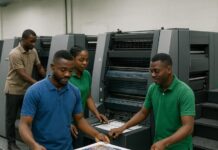
A new high-speed secure printing solution has been introduced by Konica Minolta Business Solutions U.S.A., Inc. in partnership with TROY Group. While it may seem like just another equipment launch abroad, it carries real implications for Nigeria’s print and financial sectors.
At the heart of this development is a specialized printer designed for MICR (Magnetic Ink Character Recognition) printing—used mainly for cheques and other sensitive financial documents. In a country like Nigeria, where cheque usage still exists alongside digital payments and where financial fraud remains a concern, this kind of technology speaks directly to a growing need: secure, verifiable print production.
Why It Matters Locally
In Nigeria today, many banks, microfinance institutions, government agencies, and even large corporations still rely on printed financial documents. However, a significant portion of this printing is either outsourced to general print shops or handled with equipment that lacks advanced security features.
This is where solutions like the TROY AccurioPrint 2100 MICR become relevant.
The machine is built specifically to:
- Prevent cheque fraud
- Ensure compliance with banking standards
- Handle high-volume secure printing efficiently
One standout feature is its anti-fraud toner technology, which reacts visibly if a document is tampered with—something that could be highly valuable in Nigeria, where cheque alteration and document forgery still pose risks.
Opportunity for Nigerian Print Businesses
For commercial printers in Nigeria, this signals a potential shift in opportunity.
Rather than focusing only on traditional jobs like books, flyers, and packaging, print service providers can begin to explore secure document printing as a niche market, including:
- Cheque printing for smaller financial institutions
- Security documents for government agencies
- Certificates, transcripts, and official records
Printers who invest in secure printing capabilities could position themselves as trusted partners to banks and institutions—moving up the value chain and away from price-driven competition.
A Push Toward Specialization
The Nigerian print industry has long struggled with commoditization—where “anyone with a printer” competes on price. But technologies like this highlight the future: specialized printing services that require expertise, certification, and trust.
This is especially important as:
- Financial regulations tighten
- Fraud prevention becomes a priority
- Organizations look to centralize and control sensitive printing
The Bigger Picture: Security + Efficiency
Beyond security, the printer also delivers speed and automation—producing up to 100 pages per minute and handling large monthly volumes. For Nigerian organizations dealing with bulk document processing, this combination of speed, accuracy, and security is critical.
It also aligns with a broader global trend: integrating software, workflow automation, and intelligent systems into print production. Nigerian printers who embrace this shift will be better positioned to compete—not just locally, but regionally.
Final Take
While this launch is happening outside Nigeria, the message is clear: the future of printing is not just about ink on paper—it’s about trust, security, and specialized value.
For Nigeria’s print industry, this is both a wake-up call and an opportunity.
Those who adapt—by investing in secure technologies, upgrading skills, and targeting high-value sectors—will not only survive the changing landscape but lead it.