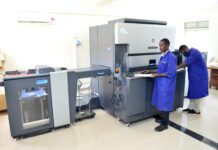
For Nigerian printers handling books, especially short-run and customized jobs, production efficiency can make a major difference. When every book has a different specification, managing book blocks manually can slow down production, increase handling time, and create room for errors.
Muller Martini’s new Separo PRO is designed to address this challenge by making automated book-of-one production easier for full-service print shops.
The system automatically separates pre-glued or thread-sewn book blocks for both softcover and hardcover production. Whether the blocks vary in thickness or format, the Separo PRO is designed to handle them efficiently, separating the blocks from stack to stack without disrupting their sequence.
Keeping Every Book in the Right Order
One of the key features of the Separo PRO is its first-in, first-out (FIFO) operating principle. This means book blocks leave the system in the same order in which they were stacked.
For printers dealing with personalized books, educational materials, corporate publications, or other jobs where the sequence matters, this can simplify production and reduce the need for additional manual sorting.
The system also has a bypass function that allows individual separated book blocks or stacks of single sheets to move directly through the production line when required.
Designed to Fit Different Production Setups
Flexibility is another important part of the Separo PRO. It can be integrated into different production environments, including inline configurations with Muller Martini’s Vareo PRO and Antaro Digital perfect binders, as well as the Diamant MC hardcover book lines.
For print businesses looking to make short and medium runs more commercially viable, this type of automation can help reduce unnecessary manual intervention while improving the reliability and output of the production process.
The Separo PRO can also be manually loaded, giving printers greater flexibility depending on the nature of the job.
Speed Meets Productivity
The Separo PRO can achieve up to 2,000 cycles per hour, while run production can reach up to 4,000 book blocks per hour under defined conditions.
According to initial field experience, the system has delivered productivity gains of up to 30 per cent.
For print companies operating in a market where customers increasingly want shorter runs, faster turnaround and more customized publications, improvements like these can have a direct impact on production costs and overall profitability.
As Nigerian printers continue to explore automation and more flexible production methods, technologies such as the Separo PRO point to a wider industry shift: the ability to produce fewer copies efficiently is becoming just as important as producing thousands.