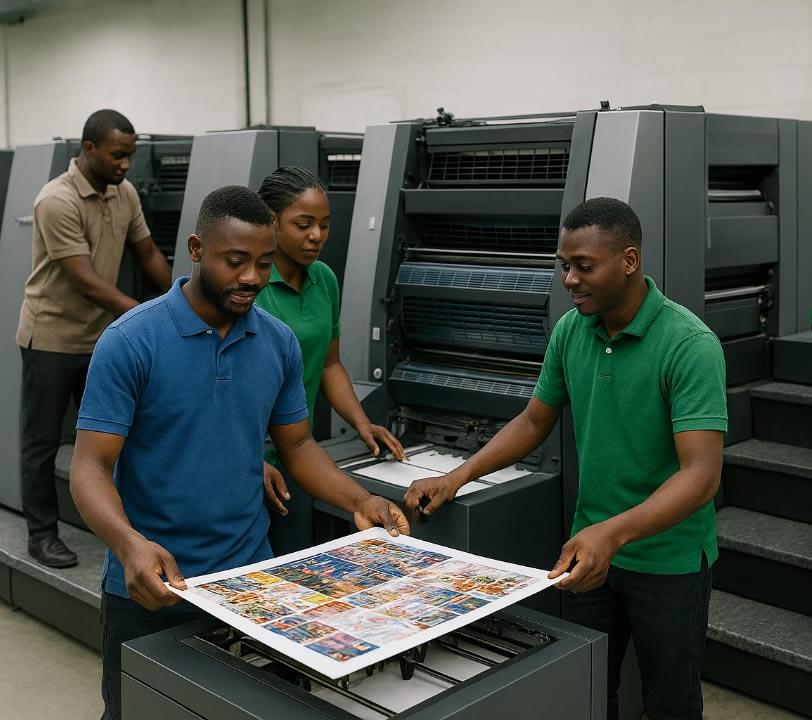


For many Nigerian printers, the biggest challenge today is no longer finding work. It is finding a way to remain profitable after the job has been delivered.
Across the printing industry, the cost of doing business has continued to rise. Paper and other consumables are more expensive, electricity remains unreliable, diesel and petrol costs have increased, equipment maintenance is costly, and imported machinery, spare parts and materials are heavily affected by exchange-rate pressures. Yet, at the other end of the business, customers are still asking the familiar question: “How much is your best price?”
This is creating a difficult situation for printers. They are expected to deliver quality work faster and at competitive prices, even when the cost of production has changed significantly.
For a printing company, every job now involves much more than ink and paper. There is the cost of powering machines, paying skilled operators, maintaining equipment, transporting materials, handling finishing, managing staff and meeting delivery deadlines. When these expenses are not properly reflected in the final price, a printer may complete more jobs and still make less money.
The Paper and Consumables Challenge
Paper remains one of the most important cost components in commercial printing, and its price can have an immediate impact on quotations. The same applies to inks, plates, chemicals, films, adhesives, binding materials and finishing supplies.
For printers who depend heavily on imported materials, fluctuations in the foreign exchange market can make pricing particularly difficult. A quotation prepared today may no longer be profitable when materials have to be purchased weeks later.
This has made proper costing more important than ever. Printers can no longer afford to estimate jobs based only on what competitors are charging. The real question should be: What does this job actually cost us to produce, and what margin do we need to remain in business?
Power: The Hidden Cost of Printing
Electricity is another major concern. Where public power supply is unreliable, printers often have to depend on generators or alternative energy sources to keep production moving.
But the cost goes beyond fuel. Generators require servicing, repairs, and replacement parts. Machines also consume significant amounts of power, particularly during long production runs. These costs may not appear on a customer’s invoice, but they directly affect the printer’s bottom line.
This is why energy efficiency is becoming a business issue, not simply an environmental one. Printers that invest in more efficient equipment, better production planning, and solar or hybrid energy solutions may be able to reduce some of the pressure over time.
The Danger of Competing Only on Price
Perhaps the most worrying development is the growing tendency among some printers to reduce prices simply to win jobs.
Competition is normal in any industry, but price-cutting can become dangerous when the selling price falls below the actual cost of production. A printer may win the customer but lose money on the job.
The result is a cycle that is difficult to escape: lower prices lead to lower margins; lower margins make it harder to maintain equipment and retain skilled workers; poor maintenance affects productivity and quality; and declining quality eventually affects customer confidence.
The industry therefore needs to move beyond the idea that the cheapest printer is automatically the best option. Customers should also understand that quality, reliability, turnaround time, finishing, and consistency all have a cost.
Efficiency May Be the New Competitive Advantage
Survival in the current environment will require more than simply increasing prices. Printers must also look closely at how efficiently they operate.
Reducing paper waste, controlling spoilage, improving workflow, maintaining machines properly, training operators, and adopting appropriate digital tools can make a significant difference. A printer who produces a job with less waste and fewer production delays has a better chance of remaining profitable than one who simply tries to increase sales.
Technology will also play an increasingly important role. Automation, digital workflow systems and artificial intelligence are changing how jobs are designed, prepared and produced. The objective should not be to adopt technology because it is fashionable, but to identify where it can reduce waste, improve productivity and help businesses serve customers better.
A Business, Not Just a Printing Press
Perhaps the most important mindset shift for Nigerian printers is to begin seeing the printing company strictly as a business rather than simply a production operation.
A busy machine does not necessarily mean a profitable company.
Printers need accurate costing, proper financial records, realistic pricing, and a clear understanding of which jobs generate profit and which ones consume valuable resources without adequate returns. They also need to communicate openly with customers when production costs change rather than continuously absorbing increases that the business cannot sustain.
There is also an opportunity to move into higher-value services. Instead of competing only for routine printing jobs, printers can differentiate themselves through packaging, commercial branding, specialized finishing, variable-data printing, short-run digital production, and other services where expertise and value matter more than price alone.
Can Nigerian Printers Survive?
Yes, but survival will require a different approach.
The Nigerian printing industry has survived difficult economic periods before, and its resilience remains one of its greatest strengths. However, resilience alone cannot replace sound business strategy.
The printers most likely to thrive in the current environment will be those that understand their numbers, control production waste, invest carefully in technology, manage energy costs, and charge prices that reflect the true value of their work.
The industry doesn’t just need more printing jobs. It needs more profitable printing jobs.
As production costs continue to rise, the real question for Nigerian printers is no longer whether they can keep their presses running. It is whether they can keep those presses running profitably and sustainably.
That may well be the defining business challenge for the Nigerian printing industry in the years ahead. If you want, I can also adapt this into a punchier, magazine-style Printers Digest feature with a stronger opening hook, pull quotes, and subheadings suitable for the actual page layout.