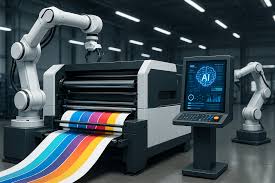


The Pressroom Is Getting Smarter
When you walk into a progressive print facility today, you’ll notice something different. The presses still buzz. The substrate still feeds. The ink still drifts. But behind the scenes, there’s a silent revolution unfolding — driven by artificial intelligence, automation, and smart data systems.
This is definitely not some sci-fi movie; the modern pressroom is already here-connected, optimized, and increasingly running itself. Machines now talk to each other, software predicts maintenance issues before they cause downtime, and production managers make split-second decisions based on live, real-time data instead of just guessing.
Forget the science fiction – this is what printing looks like today. Imagine a floor where machines actually talk to each other, and your software catches errors before they happen. In a world of shrinking timelines and high demands, this kind of tech is a lifeline, not a luxury. If you want to stop guessing and start winning, this is your edge.
AI in Print: From Buzzword to Bottom Line
(AI) Artificial intelligence is no longer a futuristic notion reserved for tech conferences — it is becoming a practical business tool across industries, with Print inclusive. What was once a buzzword is now silently driving efficiency, cost control, and revenue growth in forward-thinking print businesses.
In the print sector, artificial intelligence is reshaping and transforming operations at different levels. From smart job estimation and automated prepress workflows to predictive maintenance on presses and intelligent inventory management, AI reduces waste, minimizes downtime, and improves turnaround times. Instead of relying solely on manual planning and reactive decision-making, print companies can now use data-driven insights to optimize production schedules and pricing models.
On the customer-facing side, AI allows for personalization at scale. Variable data printing, powered by intelligent data analytics, enables printers to produce highly targeted marketing materials that improve response rates and client ROI. AI tools can also analyze purchasing patterns, helping printers anticipate client needs and recommend profitable upsell opportunities.
Importantly, AI improves — rather than replaces — human expertise. Designers use AI-assisted tools to generate layouts faster and proofread them. Sales teams leverage AI-driven CRM systems to identify high-value prospects. Management teams rely on dashboards that convert complex operational data into actionable insights.
Artificial Intelligence (AI) is no longer confined to Silicon Valley. It has found a home in the print shop — quietly improving accuracy, reducing waste, and accelerating throughput.
Smarter Prepress
- AI-powered prepress tools now:
- Automatically detect file errors
- Optimize imposition layouts
- Enhance images and correct color inconsistencies
- Flag potential production bottlenecks before plates are made
Instead of reactive troubleshooting, printers are moving into predictive mode.
Predictive Maintenance
Downtime is expensive. With AI-driven monitoring systems, presses can now:
- Track vibration patterns
- Monitor temperature and wear
- Alert operators before a breakdown occurs
Imagine changing parts before failure — not after. That shift alone can save thousands in lost production hours.
Automation: The Silent Productivity Multiplier
Automation has shifted from being an optional upgrade to a strategic necessity. By handling repetitive tasks in the background, it streamlines operations and minimizes errors, allowing your team to scale without a massive price tag. It is a subtle way to multiply your overall output.
In the print and publishing industry, automation is reshaping workflows from prepress to post-production. Automated job ticketing systems, workflow software, and press calibration tools eliminate repetitive manual tasks, shorten turnaround times, and ensure consistency across jobs. Instead of operators manually checking files, routing approvals, or adjusting machine settings, intelligent systems handle these processes with speed and precision. If AI is the brain of the smart pressroom, automation is the muscle.
Automation in print is about removing manual touchpoints — the repetitive tasks that slow down workflow and introduce human error.
Modern print shops are adopting end-to-end workflow systems such as:
- EFI workflow platforms
- Heidelberg Prinect
- HP PrintOS
- These platforms connect:
- Job submission
- Prepress
- Scheduling
- Press output
- Finishing
- Shipping
The result? Jobs move seamlessly from file upload to final dispatch with minimal intervention.
Workforce 2.0: Reskilling for the Smart Era
Here’s the truth: technology is transforming roles — not eliminating them.
The operator of yesterday manually adjusted controls.
The operator of today interprets dashboards.
The operator of tomorrow will manage automated ecosystems.
Printers investing in training are seeing measurable gains:
- Higher employee engagement
- Faster adaptation to new systems
- Reduced resistance to automation
The smart pressroom demands hybrid talent — part technician, part data analyst, part production strategist.
Forward-thinking companies are partnering with equipment suppliers and software providers to build training pathways that ensure technology adoption delivers ROI.
Because technology without people is just hardware.
Looking Ahead: What’s Next?
The future of print + tech will likely include:
- Greater AI-powered color management
- Fully autonomous press calibration
- Augmented reality troubleshooting for operators
- Real-time remote diagnostics from manufacturers
- Cloud-based production benchmarking across continents
The future of the pressroom may not be fully robotic — but it will certainly be fully intelligent.
Final Impression: Smarter, Not Harder
The printing industry has never stopped evolving, moving from letterpress to offset, and analog to digital. Now, AI and automation are just the next chapter in that story.
The question is not just whether the smart pressroom is coming.
It is whether your business will lead the transformation — or race to catch up.
Because in today’s landscape, the most powerful competitive advantage is not just ink on substrate.
It is the absolute intelligence behind the press.