For decades, folding carton production has been driven by one simple philosophy: produce more, produce faster, and reduce the cost per unit.
That model worked when manufacturers placed large orders that remained unchanged for months or even years. Printing companies could confidently schedule long production runs, spread setup costs across thousands of cartons, and maximize the efficiency of their offset presses.
But Nigeria’s packaging market is changing rapidly.
Today’s brand owners are introducing new products more frequently, targeting different regions with customized packaging, complying with evolving regulatory requirements and responding faster to changing consumer preferences. As a result, packaging orders are becoming smaller, more varied and far more frequent.
For packaging converters, success is no longer determined simply by how many sheets a printing press can produce in an hour.
The real competitive advantage now lies in how efficiently a business can manage multiple short-run jobs without sacrificing profitability, quality or delivery time.
Nigeria’s Packaging Market Is Evolving
Across Nigeria, sectors such as food and beverages, pharmaceuticals, cosmetics, personal care and consumer goods are expanding their product portfolios.
Walk into any supermarket in Lagos, Abuja, Port Harcourt or Kano, and the evidence is everywhere.
Manufacturers now offer family packs, sachets, travel sizes, promotional editions, festive packaging, multilingual labels and retailer-specific products, all requiring different packaging designs and quantities.
The pharmaceutical industry faces similar demands.
Medicines often require updated regulatory information from NAFDAC, revised dosage instructions, multiple language variations for export markets, and frequent design updates to meet compliance standards.
Although overall packaging demand continues to grow, the average production run for each Stock Keeping Unit (SKU) is becoming smaller.
This changing landscape is forcing packaging companies to rethink how they operate.
From Mass Production to Mass Customization
The future of folding carton production is no longer about producing one design in massive quantities.
It is about producing many different versions quickly, accurately, and profitably.
Today’s packaging converter may receive an order for five or six different product variants from the same customer, each requiring different artwork, colors or regulatory information.
Instead of treating these as separate production headaches, successful converters are learning to manage them as part of one integrated workflow.
Customers increasingly prefer suppliers capable of handling both large-volume production and smaller customized orders under one roof.
For Nigerian converters, this flexibility is becoming a major competitive advantage.
Why Digital Printing Is Becoming More Relevant
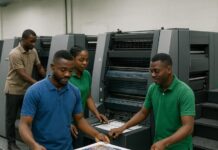
Traditional offset printing remains an excellent choice for long production runs where artwork remains unchanged.
However, shorter production cycles and increasing product variation are exposing some of offset printing’s limitations.
Every new design requires fresh printing plates, additional setup time, and more paper waste before production even begins.
When several short-run jobs are scheduled in a single day, these repeated setup processes consume valuable production time and reduce profitability.
Digital inkjet technology is helping many converters overcome these challenges.
One solution attracting attention globally is Agfa’s Speed Set Orca 1060, a high-performance digital inkjet press designed specifically for folding carton production.
The system offers multiple operating modes, allowing converters to prioritize either maximum speed or premium print quality depending on customer requirements.
More importantly, it eliminates many of the time-consuming processes associated with conventional printing.
There are no printing plates to manufacture or store.
Job changeovers take only a few minutes.
Multiple packaging materials, including paperboard and lightweight corrugated board, can be processed on the same machine.
This gives converters far greater production flexibility.
Turning Short Runs into Profitable Business
In today’s Nigerian market, promotional campaigns, seasonal offers and product launches often require several packaging variations within a single order.
Under conventional offset production, every version demands its own set of printing plates and separate press setup.
This increases production costs, extends delivery schedules and creates unnecessary waste.
Digital production changes that equation completely.
Instead of replacing printing plates for every design variation, operators simply load a new digital file.
Whether printing six different beverage flavors, multiple pharmaceutical strengths, or region-specific packaging, production becomes significantly faster and more economical.
For converters handling dozens of small jobs each week, these savings accumulate quickly.
- Reduced setup time
- Lower material waste
- Faster turnaround
- Greater profitability
Smart Workflow Makes the Difference
Modern packaging production is no longer driven by machinery alone.
Software has become just as important.
Workflow management platforms such as Agfa Asanti automate many of the repetitive tasks involved in production planning, color management, and job preparation.
Instead of relying entirely on one highly experienced operator, automation helps standardize processes across the factory.
As production schedules become increasingly fragmented, this level of consistency becomes invaluable.
Advanced workflow systems can also organize printed jobs according to delivery destinations, simplifying logistics while reducing fulfilment costs.
For Nigerian packaging companies serving distributors across multiple states, this translates into smoother operations and better customer service.
Offset Printing Still Has an Important Role
The rise of digital packaging does not signal the end of offset printing.
Far from it.
Large-volume, repeat orders remain well suited to conventional offset technology.
Where artwork remains unchanged, and production quantities are high, offset continues to deliver excellent cost efficiency.
What has changed is the proportion of work that fits this traditional model.
Increasingly, packaging converters are managing a blend of long-run and short-run production.
Businesses capable of combining both technologies will be better positioned to meet the diverse needs of today’s customers.
Adapting to Nigeria’s New Packaging Reality
- Nigeria’s packaging industry is entering a new era.
- Consumers expect more choice.
- Manufacturers want greater flexibility.
- Retailers demand faster replenishment.
- Regulators require frequent information updates.
- Export markets call for multilingual packaging.
- Every one of these trends points toward shorter production runs and greater product variation.
- For packaging converters, adapting is no longer optional.
- It is essential for long-term growth.
The Future Belongs to Flexible Converters
The most successful packaging companies in the years ahead will not necessarily be those with the biggest factories or the fastest presses.
They will be the businesses that can respond quickly to changing customer needs without compromising quality, delivery schedules or profitability.
Solutions like the Agfa Speed Set Orca demonstrate how digital production can complement traditional offset printing, giving converters the flexibility to manage today’s increasingly complex packaging environment.
- For Nigerian converters, the message is clear.
- The market is changing.
- Customer expectations are changing.
- Production economics are changing.
Those who embrace flexible technology, smarter workflows, and modern production strategies will be best positioned to capture the growing opportunities within Nigeria’s expanding packaging industry.
In today’s competitive marketplace, success is no longer defined simply by how much you can print.
It is defined by how quickly you can adapt.