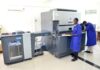
The Future of Printing Is No Longer About Machines Alone
For decades, success in the printing business was measured by one question: How many jobs can your press produce in a day? Today, that question has changed dramatically.
In an increasingly digital economy, the most successful print companies are no longer competing solely on the size of their presses, the number of colors they can print, or even the speed of production. Instead, they are competing on something far more valuable—how intelligently they manage information, automate operations, and deliver exceptional customer experiences.
The printing press remains the heart of the business, but data has become its brain.
Across Europe, Asia and North America, connected printing is transforming the way print businesses operate. In Africa, and particularly in Nigeria, the transition has begun. While many businesses are still battling familiar challenges such as unstable power supply, rising production costs, exchange rate volatility and expensive imported consumables, another challenge is quietly reshaping the industry: customers now expect faster, simpler and more transparent printing services.
They want to upload artwork online, receive instant quotations, monitor production progress, approve proofs remotely, make digital payments and receive deliveries without endless phone calls.
The printers who can provide this experience are steadily gaining a competitive advantage.
Printing Has Entered the Age of Connectivity
Connectivity means much more than having an internet connection.
It means every part of the production chain, from quotation to delivery, is digitally linked, allowing information to flow automatically instead of manually.
Imagine a customer requesting 20,000 product labels. Instead of exchanging dozens of emails and WhatsApp messages, the customer uploads artwork through an online portal. The system automatically checks file specifications, generates an estimate, schedules production, alerts prepress, updates inventory, monitors machine availability, and informs logistics when the job is completed.
Throughout the process, both the customer and production managers can monitor progress in real time.
No unnecessary paperwork.
No duplicated data.
No costly communication errors.
This is the connected print business.
Data Is Becoming the Industry’s Most Valuable Resource
Many printing companies already possess enormous amounts of information.
Customer histories.
Machine performance records.
Material consumption.
Production timelines.
Delivery records.
Repeat order patterns.
Unfortunately, much of this information remains buried inside filing cabinets, spreadsheets, or the memories of experienced staff.
Modern printing companies are learning to convert these everyday records into business intelligence.
Production data can reveal which jobs generate the highest profits.
Customer analytics can identify clients likely to reorder.
Machine data can predict maintenance before costly breakdowns occur.
Sales information can highlight emerging market opportunities.
Rather than making decisions based on assumptions, connected printers increasingly rely on measurable evidence.
Data is replacing guesswork.
Digital Workflows Are Eliminating Expensive Bottlenecks
One of the greatest hidden costs in printing is not ink.
It is delay.
Many Nigerian print businesses still depend on manual approvals, handwritten job tickets, repeated artwork corrections and multiple communication channels.
Every delay consumes valuable production time.
Every unnecessary approval increases operating costs.
Digital workflow systems eliminate many of these bottlenecks.
Jobs move automatically from sales to design, from design to prepress, from prepress to production and finally to finishing and dispatch.
Departments work from one central source of information rather than multiple disconnected files.
Errors reduce dramatically.
Turnaround times improve.
Customers notice the difference.
In today’s competitive market, speed has become part of the product itself.
Customer Experience Has Become a Powerful Marketing Tool
The quality of printing still matters.
But increasingly, customers judge printers long before the first sheet enters the press.
Was requesting a quotation easy?
Did someone respond quickly?
Could artwork be approved conveniently?
Was delivery communicated professionally?
Did the customer receive updates without asking?
Could invoices be paid electronically?
These seemingly simple interactions shape business relationships.
A customer who enjoys a smooth ordering experience is far more likely to return, even if another printer offers a slightly lower price.
Convenience has become a competitive advantage.
Professional communication has become a sales strategy.
Trust has become a measurable business asset.
The Rise of Online Print Services
Around the world, web-to-print platforms continue to reshape commercial printing.
Businesses can now order business cards, packaging, labels, promotional materials, and marketing collateral entirely online.
Templates simplify ordering.
Automated pricing reduces administrative work.
Cloud-based proofing speeds up approvals.
Customers can reorder previous jobs with a single click.
While Nigeria’s print market still relies heavily on personal relationships, digital ordering platforms are steadily gaining acceptance among corporate organizations, educational institutions, manufacturers, and retailers.
The next generation of buyers expects digital convenience.
Printers who ignore this shift may gradually lose relevance.
Artificial Intelligence Is Quietly Entering Print Production
Artificial Intelligence is no longer limited to technology companies.
Within printing, AI is beginning to automate file inspection, color optimization, production scheduling, predictive maintenance, customer service chatbots, and inventory forecasting.
Instead of replacing skilled professionals, AI increasingly supports them.
Prepress operators spend less time correcting routine errors.
Sales teams respond faster to enquiries.
Production managers receive early warnings before equipment failures occur.
Management gains better visibility into overall business performance.
The result is not fewer people.
The result is smarter operations.
Connected Businesses Make Better Decisions
The most successful printers rarely make decisions based solely on instinct.
They know exactly:
- Which customers generate recurring revenue.
- Which products deliver the strongest margins.
- Which machines experience frequent downtime.
- Which production stages create unnecessary waste.
- Which employees require additional training.
- Which market sectors are growing fastest.
This visibility allows businesses to invest wisely rather than react emotionally.
When decisions become data-driven, profitability becomes more predictable.
The Nigerian Opportunity
For Nigerian printing companies, becoming digitally connected does not necessarily require purchasing expensive new presses.
The transformation can begin with practical steps.
Digitizing customer records.
Implementing cloud-based job tracking.
Introducing online quotation systems.
Improving internal communication.
Automating repetitive administrative tasks.
Training employees to use digital workflow software.
Collecting production data consistently.
Small improvements accumulate into significant competitive advantages.
In a market where rising operating costs continue to challenge profitability, efficiency often delivers greater returns than expansion.
The Future Belongs to Connected Printers
The print industry has always evolved.
From letterpress to offset.
From offset to digital printing.
From analogue prepress to computer-to-plate technology.
Today, another transformation is underway.
The future belongs not simply to companies with bigger presses, but to businesses that connect people, processes, technology and information into one intelligent production ecosystem.
Customers are demanding speed.
Brands expect consistency.
Supply chains require transparency.
Markets reward agility.
In this new era, every quotation, every production update, every customer interaction and every piece of operational data contributes to competitive advantage.
Printing is no longer just about putting ink on paper.
It is about connecting technology with service, intelligence with production, and innovation with customer satisfaction.
For Nigerian printers prepared to embrace this shift, the greatest opportunity may not lie in printing more; it lies in printing smarter, serving better, and building businesses where data, digital workflows, and outstanding customer experiences become the true engines of sustainable growth.
Printers Digest Insight
The future of print will not be determined solely by faster presses or lower production costs. It will be shaped by how effectively printers harness data, automate workflows, and create seamless customer experiences. As digital transformation accelerates across industries, print businesses that invest in connectivity today will be the ones setting tomorrow’s standards for efficiency, profitability and customer loyalty.