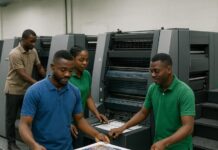
The field of printing technology is one in which many of its practitioners started in an informal educational system format tagged “Printing apprenticeship” in Nigeria, an arrangement in which someone learns the art of the printing profession under another (The master) for an agreed number of years.
The printing apprenticeship could be seen as one of the reasons why many likened the profession of printing to be for the ‘semi-illiterate’, as it underlies the dearth of non-academic, hands-on skill training programs for printing, and hoping for a universal solution for such practitioners becoming educated in a formal setting probably isn’t realistic.
In the early years of printing in Nigeria, the printing profession was relegated on the background by many who sees it as the missionary man’s work of propagating the Gospel, until 1952 when the Yaba Technology took the bull by its horn to establish the printing technology department in the school
From a craft-based trade, the field of printing in Nigeria has indeed metamorphosed into a profession driven by computers and hi-tech devices through formal education in the higher institutions of learning offering printing technology as a course of study and has brought about a radical change in the way printing practitioners carry out their businesses in their workplaces thereby resulting in better print quality, faster production and higher profit for print investors – comparable to what obtains when printing was carried out in an unprofessional manner.
Here are the accredited higher institutions offering Printing Technology in Nigeria
(1) Yaba College of Technology, Lagos.
(2) Kaduna Polytechnic, Kaduna.
(3) Institute of Management Technology, Enugu.
(4) Kano State Polytechnic, Kano.
(5) Federal Polytechnic, Oko, Anambra State.
(6) Benue State Polytechnic, Ugbokolo, Benue State.
(7) Hussain Adamu Federal Polytechnic,Kazaure.
The Department of Printing Technology in Yaba college of Technology being the pioneer of printing education in Nigeria was first established in 1952 but merged with the Department of Art in 1964. With the introduction of the school system, the Printing Technology Department was reestablished under the School of Art, Design, and Printing Technology.
In the early years of the Department, it offered day-release courses in the various areas of printing technology for the benefit of people involved in printing industries, publishing industries, and other industries and has contributed immensely to the technical manpower for the need of the printing industry in the country. The examinations were conducted on those courses that led to the award of the City and Guides Certificate from London. From 1953 to the sixties, the Department admitted and trained students for junior diploma and certificate programs. The Certificate courses were terminated and replaced by a two-year National Diploma Certificate in 1977. Sequence to this was the approval of the Higher National Diploma Programme in 1978. The first set of diplomats who had successfully completed the National Diploma courses pioneered the first set of students who were made to continue the Higher National Diploma program in 1979. In 1981, the first set of Higher National Diploma students graduated. Yabatech can be described as the cradle of printing education and has produced pillars in the printing industry and most of them occupied some top prominent positions in the printing and publishing industries in Nigeria. Some of the notable alumni of the printing department of Yaba college of technology are Sir John Onuegbulem of Heidelberg Nigeria, the first vice president of the Chartered Institute of Professional Printers of Nigeria (CIPPON), Comrade Babajide Salako among others.
Also, the establishment of other printing technology departments in different higher institutions in Nigeria have all contributed to the growth and development of printing education in the country, thereby causing the printing sector to witness a tremendous transformation from a craft-like sector to a sector controlled by the elites who are educated, exposed and avid travelers in search of new technologies and innovations to add to their businesses.
Despite this development witnessed through printing education in this sector, a lot is yet to be achieved and that calls for an urgent need to appraise the state of printing education in Nigeria. Such an appraisal will bring to the fore the availability and adequacy of printing programs in the nation’s printing education system. This will provide necessary insights for policymakers and stakeholders to put in place policies and programs that will propel the manpower development plan for Nigeria’s printing industry.