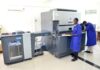
— Graphco, Midwest and Southeast distributor for RMGT and a recognized supplier of offset, digital, and finishing technologies, has confirmed the successful installation of a four-color RMGT 970 perfecting press at Meridian’s Loves Park, Illinois production facility near Rockford.
Completed in 2025, the investment represents a strategic enhancement of Meridian’s manufacturing infrastructure as the company continues to prioritize performance, efficiency, and production versatility.
Strategic capacity expansion
Headquartered in the Midwest United States, Meridian operates three integrated production sites alongside five fulfilment and distribution centers, delivering comprehensive print and marketing collateral management services. With more than four decades of industry experience, the company serves a diverse national clientele spanning healthcare, manufacturing, retail, nonprofit, and other sectors.
The RMGT 970 Perfector was selected as a right-sized solution capable of handling Meridian’s diverse job mix. Transitioning from a three-quarter-size sheet platform to a full 25″ × 38″ format, the press enables efficient production of the majority of general commercial work without the capital and spatial demands associated with a 40-inch offset press.
Meridian CEO Bob Chanson noted that the investment aligns with the company’s long-standing commitment to deploying advanced, operator-friendly technology.
Flexibility at the heart of production
Designed to operate as both a two-over-two perfector and a four-color straight press, the RMGT 970 delivers the adaptability required in today’s commercial print environment.
For Meridian, this versatility has translated into tangible operational benefits. According to Director of Operations Marc Scordato, the press has effectively become the “Swiss Army knife” of the company’s pressroom, enabling single-pass two-over-two production while allowing rapid transition to four-color straight work.
Such flexibility supports shorter turnaround times, reduced makeready complexity, and improved job scheduling efficiency.
Performance and workflow optimization
The press incorporates RMGT’s double/double/single-diameter cylinder perfecting mechanism, enabling speeds of up to 15,000 sheets per hour while maintaining accurate sheet control.
Integrated LED curing technology further enhances productivity by delivering instantly dry sheets, allowing printed work to move directly into finishing without intermediate delays. Meridian reports that the LED capability has eliminated historical post-press bottlenecks and significantly improved throughput.
In addition to workflow acceleration, the Benford LED curing system delivers measurable sustainability and cost benefits. Compared with conventional UV systems, it consumes less energy and removes the need for spray powder, contributing to a cleaner pressroom environment and reduced operating expenses.
Partnership-driven investment
Graphco Regional Vice President of Sales Derek Gordon highlighted Meridian’s data-driven approach to equipment selection, noting that production analysis showed the RMGT 970 Perfector could handle approximately 95% of the company’s general commercial workload while delivering the flexibility required for future growth.
Graphco President Chris Manley also commended the partnership, emphasising Meridian’s strategic alignment of technology investments with evolving customer requirements.
Industry relevance
Meridian’s installation reflects a broader global trend in commercial print toward mid-format offset platforms that combine versatility, automation, and energy-efficient curing technologies. For many printers, such investments provide a pathway to balance productivity gains with manageable capital expenditure while supporting increasingly complex job portfolios.
As market dynamics continue to favor shorter runs, faster turnaround, and multi-application capability, equipment that delivers both flexibility and efficiency is rapidly becoming a cornerstone of competitive print manufacturing.